Thursday, August 6, 2015

Things That Go Bump in the Night

"My skipper looks after me, and in turn I look after him"- Corleto

We were finally away and our heading was to places we had not been to before. This was part two of our summer on Corleto. As we slipped away from the dock at Horseshoe Bay, there was a certain relief that we had managed to pack everything without too much fuss.

As it was after 6 and with a prawn trap to collect as we departed, it occurred to Charlene that daylight would be fading soon. After hauling two dozen prawns we at least knew that our meal when we got to our anchorage would be fresh seafood.

With Charlene at the helm and me at the anchor locker on the bow, we arrived and set our Danforth with little fanfare. Both of us now ready for a taste of our catch, relieved that we managed to get to Plumper Cove before dark.

After our late supper, we decided to take a swim around midnight. It was the first time I experienced "luminescence" in the water. Stars seemed to shoot out of my fingertips, my arms and my legs. That was pretty neat. All in all, we were off to a good start to sailing adventure part II.

Charlene doing some Yoga before setting out from Plumper Cove

The second leg of the journey however was to have its challenges. The weather had decidedly cooled. The South East wind was now 20- 25 knots, but since we were traveling north, we would have the wind and waves to our back. I decided that we would motor as Charlene was having some difficulty getting her sea legs.

Another Yoga position- Downward Facing Sea Dog

With a following sea and a strong tail wind, the boat surfing along. Corleto was managing a pretty constant speed of 6 knots. Charlene by now had retired to her "recovery" position on deck as I manned the helm. Gotta say there were a hell of a lot of caps, I just hoped that wherever we were to drop the hook, it would be protected enough to allow Charlene to recover.

Trying to keep a steady helm 
It was just after 2 pm when we entered Welcome Passage. I assured Charlene it would not be long before we would be out of the chop and into an anchorage. We decided on a place called Smuggler's Cove just at the north end of Welcome Passage. The entrance was narrow and shallow, but it seemed to fit the bill as a protected area to duck out of the wind and the waves. We motored our way through and observed several boats already anchored and stern tied to the shore. We continued further into the cove, transited a narrow shallow S turn into the back basin of the anchorage. There were already 4 boats there, but we found a place and dropped the hook in 18 feet of water. Charlene was looking and feeling better already. Both of us pleased we had found this little gem. There was a red shore "eyelet" for us to stern tie to the shore.

The calm of Smuggler's Cove

Stern Tying is an anchoring technique I had never attempted before. I studied how the other boats were fastened to the shore and the position of their respective anchor lines. I noticed all of the boats had a yellow "floating" line as the material of choice for this method.

All I had was my prawn fishing line, it was 400 ft, but it did not float. So I went scurried to shore and ran the line that I had, through the eyelet and then back to the boat. Funny thing about an anchorage, everybody's watching you, silently judging and critiquing your anchoring skill or in my case LACK THERE OF.

There was lady whom was out for a row around the cove. She was a crewmember of a lovely 35 footer from Seattle. She came by and struck up a conversation with Charlene. She said " It looks like you got it right" and so with that endorsement, my confidence was high with our anchor set up. I went to bed later that evening feeling good about what we had accomplished with a method that was totally foreign to me.

It was shortly before zero dark 3 am when THUD. I woke up like a shot. Charlene awoke too.
I noticed that there was a tree just off the port quarter about 15 feet away.
"We have bottomed out!" I said "Get me my life jacket" and I immediately started the engine.
I quickly checked my trusty "AYE TIDES" app to see what the tide was doing. It was falling and the low tide was not for another 2 hours. I know that we need to do something and fast. The wind is now coming up and with the pitch black, I am surprised just how calm we both are. No yelling, just urgency.

Charlene returned like a shot with my life jacket. She had her's on as well. I went overboard to the dingy to survey the situation.
Charlene reports "Murray, I cannot move the tiller"
"OK don't force it we don't want to damage the rudder." I reply.
I get myself and the dingy wedged between Corleto and the rock. Then there is a bit of a surge.
Charlene reports "The tiller is free."
After hearing her report, I jumped on, grabed the tiller, put the engine in gear and hit the throttle.
And just like that we are floating and Corleto glides away from the rocky shore. A wave of relief come over the ol' Skipper as I handed the helm to Charlene. I quickly tossed the stern lines overboard and then scampered to the bow to attend the anchor.

We reset the main anchor in the middle of the cove. We are able to swing with the wind and are far enough away from the other boats that our swing radius will not present any collision issues with any of the others.

Charlene stops the engine. We look at each other and then embrace with a reassuring hug.
"We're ok, the boat's OK. "
Needless to say neither one of us slept for the rest of the night.
Daybreak was a welcome sight.
Where it went THUMP in the night. This shot taken the next day after we went to Secret Cove to get some floating stern line.
I recovered my prawn line later in the day. In doing so I was able to figure out what had happened. The original anchor set was right on the margin. We should have anchored just a bit further out from the shore. The stern line allowed us to swing about 30 degrees and combined with the fact it did not float, it wrapped around submerged rocks as the tide fell. When the wind shifted in the night the stern line now entangled around submerged rocks now forced the boat to take the wind broadside. That pressure on the boat and the anchor tackle, it forced the anchor to drag. The next thing you know,,,, THUMP!

I did snorkel under Corleto's keel and rudder to find no damage. She may be old but she took care of her crew while teaching a valuable lesson.

She's a good boat.


Wednesday, July 15, 2015

Bart

I knew I had things growing below my water line, but above? That's a new one for me- Corleto

With the summer cruising season in full swing, we wanted to take Corleto and her newly painted bottom on a bit of a shake down cruise. I ended up with a nice week of holidays and we decided that we would get away to one of our favourite anchorages, Montague Harbour Marine Park on Galiano Island.

We wanted to provision in such a way, so as to have a number of prepared meals that would only need reheating when we were at anchor. We cooked like mad chefs the Saturday evening before our departure. Three Cheese Mac and Cheese, Shepard's Pie, Artichoke Dip and Slow Cooked Ribs just to name a few. There was of course fresh vegetables, breads and salty snacks. Water, beer, G2's and a bottle of wine. We were indeed well provisioned for our week long shake down cruise.

Charlene had this idea that she got from either the Cruising Women web site or from one of our dock mates to bring an herb garden with her so as to have fresh herbs to add to our culinary delights when at anchor. She opted for a Basil plant.

As we loaded up Corleto before departure, it became apparent that the plant was rather large for such a small craft. But undaunted Charlene proclaimed that we would need a "bigger boat". We both had a nice laugh about her rather large plant, she even gave it a name - Bart

Charlene and Bart the Basil Plant, "we're gonna need a bigger boat" she says

From then on Bart the Basil plant was one of the "crew", mascot of the galley. Posing for pictures and occasionally sacrificing a few leaves to flavour up whatever Charlene whipped up at anchor. Bart was more than a pretty plant, he proved himself to be a tasty addition to Corleto's crew.

Bart enjoying the view after the voyage across the Straight of Georgia

Bart provides some fresh leaves to earn his passage on Corleto

Bart enjoying a sunset at Montague after donating a few leaves. 

Thursday, July 2, 2015

Prawn Chasers

If you will remember, one of the things on the boat bucket list is to go and catch some spot prawns. It had actually been on the list since the beginning of my boating adventures, but it was something that always seemed to take a back seat to other more pressing Nautical tasks.

This all changed earlier this year when I attended the Vancouver Boat Show. I was not going to leave without a Prawn Trap. After walking around BC place and finding a vender with traps, I arrived to find that they had sold their last one. But I did get a deal on 400 ft of trap line, so all was not lost. A few days later I got myself a trap at the boat show price and all I needed now was the proper licence and I would become a Prawn slayer.

The prawn season opens in my area on April 1 and I of course was anxious to get the trap in the water and fish me some of those sweet tasting bottom dwellers. 
Not so fast young skipper. 

I had never fished or hauled a trap in my life, so I thought I should seek out some solid information on just how this delicious past time could be successful for a first timer. 

Of course the Nautical Yoda Richard, our boat neighbour at the Marina, had some great tips and a couple of suggestions on where to set the trap. I felt I had a good foundation. But some great advice came from an unlikely source, at the Helicopter hangar, from two of our pilots. Both were born and raised BC boys and spent a good deal of their respective youths on and around the coastal waters of the province. One of the lads had a buddy whom was a commercial prawn fishermen. He gave me tips on what bait was best. Strangely it was a particular brand of cat food and not fish heads or prawn bait pellets. The other bit of advice came in the form of potential hot spots to set my traps. 

So armed with this bit of information, I set out to score some prawns. Rigging the trap was a bit messy the first time, I ended up getting smelly bait juice all over me and the dingy. But I felt I was setting it in deep enough water, 230ft or there about I figured. I had marked the 400 feet of line with a series of red and green tape markers to indicate 10 foot increments with special marks of the 50's and the 100's. I dropped the trap into the water with great anticipation and with the hope I would at least catch a few. Only time would tell.

According to my "pilot" experts, the trap should soak for at least 4 hours and ideally be set on a rising tide. I started the little 3.5 outboard and headed back to Horseshoe bay. Back at the dock there were many boat chores that needed to be done, not the least of which was a good deck cleaning. Surprisingly the cleaning and some other minor chores melted those four hours away. In the meantime, Charlene joined me at the dock. I think she was worried about me being out on the dingy haulin' a trap without anyone with me.


The first haul
With a wave of anticipation and excitement, we shoved off from the dock to check our trap. Before long we were alongside my marker buoy and I began the task of hauling in the 400 ft line, hoping not to tangle and create a massive rats nest of the rigging.

Hand over hand. Heave ho, the task seemed great. I counted the taped markers down in my head to make the chore seem more tolerable. As the markers counted down, our excitement grew. God I hoped there would be at least two in the trap so we each could have a taste. Finally one of the clip weights came to the surface.

"Only twenty feet left" I said.

By now Charlene was peering over the side as if to use her magic powers to will a decent catch. Then all at once we could make out the frame of the trap beneath the surface. As it drew closer, we could make out that wonderful orange colour and movement of those little critters.

Success!

The first Catch!

I could not wipe the smile off my face. We ended up with 18! All a good size. Not too bad for a first timer.
A little garlic butter

There would be Spot Prawns on the menu at Chez Murman tonight.

Hey save some for me Charlene!
We have been out several times since this first catch. Some soaks successful, some,,,,, well,,,, not so much. But Prawn Chasing does add to the joy of our boating adventure and we can hardly wait to go and fish some more.


Friday, June 19, 2015

Cooling Off

"My young skipper has learned and adapted well to all of the issues I have thrown his way. I know now he's the real deal." -Corleto

There had been that over heat incident of last summer with the Brothers Kincaid. I figured the issue was the new screen raw water strainer. That same strainer also began the chain of events that resulted in the "Hot Flash". It has so restricted raw water flow that it ultimately burnt the electric raw water pump out. The pump would have to be replaced. With the pump down,  I knew that it was likely a good time to give the entire cooling system the once over.

I wished I could tell you the simple replacement of the Flo Jet Raw Water Pump was easy, but with all things Corleto, she teaches me new and exciting combinations of profanity. In the end, I realized that I needed either a third hand, or a second elbow, but settled for a new power tool, a small Impact Driver. The new wonder tool got the job done and I was able to install a new working raw water pump.

However, there is more that just a raw water pump in the cooling system. There is a mystical metal unit located at the back of the engine that is an after market modification, the Heat Exchanger. Removing anything that seems to be in good working order goes against my nature, but I needed to be 100% sure that it was working to its maximum potential. I took pics with my iPhone and labeled the hoses. This is so when I would reconnect, it would be as I had found it. Everything came out surprisingly easy, which to my suspicious and sometimes active imagination, made me a bit nervous.

The Heat Exchanger

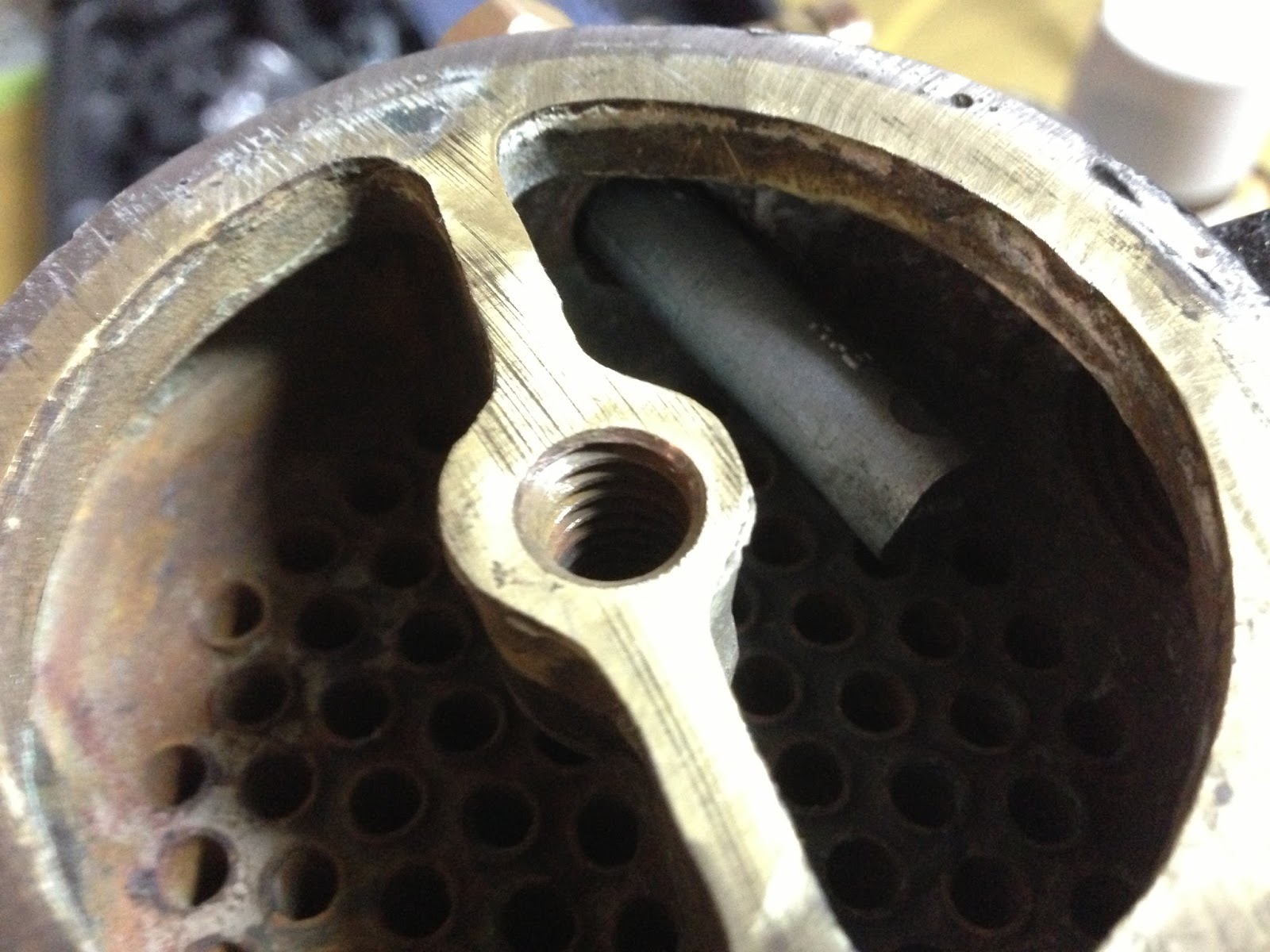
Getting the copper /brass heat exchanger in the shop was a good thing. It was covered in oxide and it seemed to rattle with bits inside the chamber. I carefully took apart the bottom cover bolt to expose a series of tubes, bits of sand, sea shell bits and a rather massive zinc deposit right around the opening for the pencil zinc bolt. I looked at it and realized that was the reason I could not get a pencil zinc into place without severe modifications to the new zinc. 

First things first, I flushed out the unit with water and then used a coat hanger wire cut to size to ream out each of the tubes. I filled the exchanger with some CLR cleaner. It immediately foamed so I figured it was getting rid of any build up inside, dissolving the crud I could not ream out with the wire. As I was letting it soak in the mixture, I read the label of the CLR bottle, to my horror the words, DO NOT USE ON COPPER jumped out at me. Shit. I began to flush out this stuff with lots of fresh water. When I checked the tubes again with my wire reamer, the tubes were now clear and free of obstructions. So the harsh CLR worked. But I am glad I did not soak the exchanger over night. A new heat exchanger was not in the budget.

I still had to remove all of the zinc build up, so I got the Dremel and removed the build up with the help of one of the Flight Engineers at Talon, Norm. It took a bit of patience, but between the two of us we got rid all of the old material and re tapped the threads to the bolt head.


Norm- Flight Engineer at Talon, re tapping the zinc bolt head

With the unit in pieces I figured I should also clean up the outside and give it a new paint job. First cleaning off all of the oxide and loose flakes of old paint with the Dremel tool. Then I sprayed a coat of primer and later two coats of paint. You would think I had a brand new part when I was finished. 
I was able to insert a full pencil zinc into the unit now that all of the old build up had been removed.

In the upper right you can see the full pencil zinc installed

The only thing left to do now, was to reinstall the exchanger to the cooling system of Corleto's engine. Before filling the unit with coolant, I thought I should check the impeller. Turns out it was on its last legs, so I installed a new one and began to fill the heat exchanger with a 50/50 mix of water and antifreeze coolant.
New impeller- Check!

All painted and hoses re attached.

The test would come when I fired up the engine and ran it under a load for 30-40 minutes and watched the TEMP gauge. Everything indicated normal.

Nominal TEMP

I breathed a huge sigh of relief, and enjoyed my victory.

Wednesday, March 18, 2015

The Hot Flash

"You know at my age I'm bound to have a hot flash or two" -Corleto

Charlene and I decided to go and take Corleto out for an early March sail. She had been very much alone for most of the winter. Her only movement came at the end of Feb. when she was relocated to a temporary berth as her normal home dock was to be replaced.

She was a bit grimy from the winters rain, but with a long glow of the plug, her engine came to life with little effort. As we dropped her dock lines and slipped out to the open water of Howe Sound, everything appeared to be normal.

I was pleased that we were beginning our third season and was pleased that we had a bit of wind so we could put the sails up. Over the winter I had both the Jib and the Main into the sail loft at North Sails for some repairs. I was anxious to have the new tell tails on the main fly and to test out the new leach line on the Jib. With Charlene at the ready, I hoisted the halyards. Charlene wrapping the sheet around the winch. I pulled the tiller to bare off the wind, Corleto's sails filled with a snap and Charlene winched in the Jib sheet. I shut the engine off and just like that we were sailing calm and relaxed, the way it should be. I glanced up at the new tell tails. They were flying straight and true. It was a zen like moment and as we both smiled at our place in time on the water. We settled in for a nice comfortable afternoon.

Charlene and I, our first sail of the season on Corleto

After a bit of tacking and gybing, we broke out the sandwiches and looked out over the water hoping to see a whale or a dolphin, you just never know in these waters. Before we knew it it was time to head back to Horseshoe Bay. Charlene had said she was beginning to get chilly so after a brief run with a wing on wing in very light air, I decided to turn on the engine and get us moving.

I left the main up, but we doused the jib and began to motor our way back. About 10 minutes or so after I started the engine, Charlene says to me, " I think the engine sounds funny". I listened, the exhaust sounded different. I looked over the back to see what was the issue. The following sea had the exhaust thru hull under the water. It was bubbling, so I figured that is the problem sound But a little feeling in my gut suggested otherwise, so I immediately checked the TEMP gauge. It was about to pin.

Shit, an OVER HEAT. I immediately stopped the engine. Then got the boat on more of a downwind course so at least we could sail toward Horseshoe Bay. Then I went below to see what the problem might be. The first place to begin is with the raw water strainer. I had replace the original one with a new higher volume one last summer. That new one had caused the Brothers Kincaid a problem last Aug. when a clogged strainer had choked off the water to an electric pump. The pump ran dry and blew an inline fuse.

A check of the strainer confirmed my theory. It was clogged. I removed it and took a tooth brush and cleaned the circular screen and flushed it with water, reinstalled it and started the engine. I watched the TEMP rise again. I stopped the engine realizing I had not checked the fuse. A quick call to my "Phone a Friend" Kinc, to inquire about the location of that fuse. He described where is was and I checked and swapped it out with a new fuse. I clicked the ignition to see if I heard the pump engage. It did not.

I dropped an F Bomb.

The pump had burnt itself into oblivion.

The wind was with us and I decided to sail back as far as we could then start the engine and get us into the dock. I was praying that I would not melt the head gasket or have the engine fail just as the ferries were coming into dock.

It took 30 minutes of so for us to get close to Horseshoe Bay under sail. With the boat now in the wind shadow of White Cliff Point, sailing was no longer an option. I dropped the main sail, started the engine and inched toward the outer marker of Horseshoe Bay. The temp began to climb. I shut her down again. Charlene suggested I call for help to one of our friends at the marina.

The tow of SHAME was not an option for this stubborn skipper.

I managed to get Corleto around the marker and again shut the engine down. She had enough forward momentum for us to continue on toward the dock. Several power boats came past with big wakes that killed our forward motion. We were about 200 yards to the dock when I decided to go ALL IN and start the engine and at very low rpms, brought her into her dock.

Back safe after her Hot Flash

Charlene was at the ready with the dock line and as soon as her foot hit the dock, I cut the engine. We were finally home. We had managed to come in with zero ferry traffic, that was good timing. A simple day's sail with some engine drama.

One thing about Corleto, there's never  a dull moment.


Sunday, November 2, 2014

September Gifts


This has been a great sailing season. Less worrisome than the first. Certainly a more confident skipper this season.  I continued to throw little curve balls to keep him on his toes. There is always something new to add to the shit list. But the operative word this year was sail. And sail we did. -Corleto

As August drew to a close and fall was on the horizon, we were blessed with wonderful warm temps and sunshine. We did our best to take advantage of this September gift. We took a wonderful trip to Plumper Cove that included one of the best return voyages we have ever experienced in the Collingwood Channel.
Winds near perfect, keeping Corleto on a starboard beam reach for pretty much the entire journey back to Horseshoe Bay. Every time we thought we would have to tack the boat, the wind would make slight directional shifts to our advantage.  As the wind began to pick up, I reefed the main and kept the boat comfortable. We had been averaging 5.4 kts for the 90 minutes or so that it took to get close to Horseshoe Bay. Then we short tacked twice before dousing our sails and started our engine to make our approach into harbour. It was the gift of a good sail. Certainly one of my favourites of the season.

Perfect day with perfect wind in Collingwood Channel

The following week took us to Bowen Island, to an anchorage that we had visited many times over the summer, but it was now Fall and we found ourselves in the water having a swim! Yes, life is good on a boat. That trip also enabled us to use a new set of headsail sheets. The originals had lost their suppleness and had often bound up in the cars and cleats when tacking or gybing. It was a constant irritation. The new lines now slipped ever so effortlessly through the cars and made tacking so much smoother. That was the gift of new sheets.

The new sheet cleated as we head to Seymour Landing
Charlene, displays the new sheet/snap-shackle attached to the drifter

Big smiles after getting out of the water, and it's the third week of September!
But of course with all of that boat use comes maintenance. The hour meter on the engine screamed it was time for an oil change. It was also time for a fuel filter and transmission fluid change. We all know how the last one went- an hour job grew into a two day ordeal. I wanted to avoid that if I could. I also had to consider a situation that Dave and Pete had found themselves in when they were on their trip with Corleto. I would have to service the cooling system. I decided that the cooling system could wait until after the up coming ONN Weekend in October, but that fluid changes would and should be complete before we cast off again.

New Oil Extractor and a seamless oil change.

The last weekend of September was dedicated to the engine. This oil change went very smoothly. Acquiring an oil extractor was a big help over last years mess. Changing out the transmission fluid and adding the precise amount called for in the Op's manual would prove to make a huge difference with the shifting into forward and reverse. And changing out the fuel filter, the task which I feared most, turned out to be almost as easy as oil change. It's only hiccup being me forgetting to fill the new filter with clean fuel before the install. But I quickly realized it when I was not getting any fuel through the bleed screw, so with a quick top up of the filter and a re-installation, the engine was purring without any hesitation. The sound was the gift of a happy engine.

I emerged out of the engine compartment with a smile and a sense of new found engine confidence. I packed up and readied the boat for what will likely be her final big weekend before the New Year- ONN 2014. We shall see what gifts October brings.


Sunday, September 14, 2014

Corleto's Affair


Skipper, I think I’d like to see other people -Corleto
Are, are you suggesting an open relationship?- SkipperMurman
No, no, I’m just talking about that weird old guy who was with you when we first met- Corleto

Kink? Oh Hell, sure. He’s harmless. -SkipperMurman


And so begins the Corleto Affair, a three night stand.

The first time, I thanked him.
The second time, I warned him.
The third time, I accepted his generous offer of the use of his beloved 27 foot Catalina sailboat, Corleto.


For the record my name is David Kincaid aka Kink or Kinc.
Murray and I met and became friends during our mutual employment at CTV British Columbia.
I was with Murray when he first laid eyes on Corleto and I may have played a small role in convincing him that she was indeed the one.

I was pleased to serve as first mate on Mur’s first voyage aboard Corleto as she emigrated from the US to Canada. Mur was appreciative of my assistance and offered me the keys to Corleto any time I wanted.
So when my older brother Peter announced a summer visit to Vancouver from his home in Australia, I decided it was time to call Murray's bluff. In an extraordinary act of trust and generosity he happily agreed and the plans for a brotherly bonding tour of the Gulf Islands was set in motion. 

On Sunday August 24, Mur met us on the dock at Horseshoe Bay to give us a familiarization tour of the boat.
However as we were moving our gear from the Jeep to Corleto, we realized Pete did not have a sleeping bag.

So while I drove back to Burnaby, Pete got a crash course in how to light the alcohol stove, reef the main and flush the head. Two of the three would prove vital to the success of the voyage.

With Pete’s sleeping bag acquired we shoved off and motored out of the marina.
We wanted to sail and even went to the trouble of raising both main and jib but the wind was not cooperative so after sailing north and south for an hour we gave up and began motoring west to our destination, Silva Bay on Gabriola Island.


Corleto’s wonderful 500 cc two cylinder eleven horsepower diesel engine pushed us along at a respectable five knots through the choppy waters of Georgia Strait.

In his youth my brother served in the Canadian Navy but that does not make him immune from seasickness. Like the great Horatio Hornblower, Pete finds the first few hours aboard a boat a difficult adjustment. So while I manned the helm, drank a beer and watched the GPS, Pete sat in the cockpit looking a bit green around the gills.


Six hours later we were alongside safe and sound in Silva Bay.

All tied up in Silva Bay

Around 9:30 we set off to transit the always tricky Gabriola Passage between Gabriola and Valdez Islands. For a boat like Corleto it’s best to negotiate the pass at slack water. Our homework paid off and we breezed through without drama.

Gabriola Passage


Our destination for the evening was Newcastle Island in Nanaimo harbor however we had time to kill before our next navigational challenge so we made for Pirates Cove Marine Park on DeCourcy Island. The entrance is shallow and tricky but I’d been in there before so had a little bit of local knowledge which served us well.

Pirates Cove Provincial Park
We dropped the hook and rowed ashore to explore the park. 

Dingy Dock, Pirates Cove, BC

Having places like this takes some of the sting out of paying tax. BC’s marine parks are a wonderful resource where wealthy Americans rub shoulders with dirt poor retired television reporters.

Like a lot of the Gulf Islands, DeCourcy has a fascinating history; most notably it was the home of the notorious Brother Twelve, a weirdo cult leader who came to the island in 1929.


Edward Wilson, better known as Brother 12


After lunch we weighed the anchor (can anyone tell me the origin of that saying) and motored out of Pirates Cove.
The sea was oily calm and the weather fine as we rounded the south end of DeCourcy but something about the engine sounded, well, different.
Corleto is not overburdened with dials, gauges, warning bells and whistles of any kind but it does have an engine temperature gauge which was pinned in the hot zone. Not good.

Then a few things happened quite quickly.

We shut down the engine.
We raised the mainsail.
We phoned the owner to ask his advice.

Mur told us about a new strainer he had recently installed on the cooling water intake. 
That proved to be full of the sediment we had stirred up in Pirates Cove. Pete then discovered the inline fuse for the water pump was cooked so we replaced it and confirmed we had good flow of sea water through the cooling system. We topped up the fresh water side of the system in case we had lost any during the overheating event. About an hour later, the engine once again perfectly happy, we were back under way feeling pretty good about ourselves.

Truth be told Peter and I have had lots of similar adventures over the years and actually relish the challenge of meeting a problem head on and dealing with it.  We sent a relieved Murman the following photograph.

Corleto- cool as a cucumber

We needed to go through Dodd Narrows at slack water which was five pm and through a combination of good luck and good planning we were exactly where we were supposed to be exactly when we were supposed to be there.


Dodd Narrows

About 7 pm we hooked up to a mooring buoy in New Castle Island Marine Park in the mouth of 
Nanaimo harbor.


New Castle Island

Downtown Nanimo from New Castle Island


That evening we might have spilled a little red wine on Corleto’s gel coat as we celebrated a pretty great day.

Tuesday August 26
Corleto’s alcohol fueled stove is a bit frightening as it requires an auxiliary fire in order to get going. After nearly setting Corleto ablaze during a previous voyage, I decided Pete would be the designated stove guy.
By now he had mastered it and we were able to enjoy morning coffee with Baileys on another chamber of commerce morning.
We motored out of Nanaimo harbor full of hope that the wind that fought us on the way over would help us on way back across Georgia Strait.
No such luck. Flatter than you know what on a plate.

The Ancient Mariner - working on his new rhyme

We rigged Murs bimini, let Otto steer and tried stay out of the sun.

Six hours later we pulled into Plumper Cove on Keats Island and again got a buoy, however this time no one came out to take our 12 bucks.
First night $50, second night $12 and the third night, FREE.

The Neighbours at Plumper Cove

We went for a nice hike through the woods to Keats Landing home to a huge Baptist church camp dating back to the twenties.

The sign at Keats Camps

By the time we got back Pete was hot and sweaty enough to do this……

Pete's all wet- a cool and refreshing dip in the cove

For dinner I prepared one of my specialities, Hamburger Helper. It was a culinary first for Peter and he now loves it almost as much as I do. As the night progressed we finished off the Scotch, the wine and the beer so clearly it’s time to go home.

Wednesday August 27

Still no wind so we motored down Collingwood Channel between Bowen and Gambier.
Very pleasant, but a little sailing would have been nice.

Flat calm on Collingwood Channel

On the northeast corner of Bowen Island is an islet called Finisterre Island which is owned by a retired lawyer. Some time ago he built a tunnel which can be accessed at low tide and is big enough to accommodate a Suzuki Samurai.

The home made Tunnel

My brother and I have long been fascinated by this ingenious bit of engineering.

Now we are heading for home. After nearly 30 hours of motoring the grumpy guy on the fuel dock was only able to separate us from 35 dollars to fill up with diesel.
Nice.

Back at Murs slip we set about cleaning up the mess we had made. Just as we finished swabbing the decks, hoping to leave Corleto at least as spic and span as we found her Murman himself hove into view. Peter and I made a discreet departure so as to leave Corleto and her skipper to become reacquainted.

The Corleto affair was brief but intensely pleasurable.

Thanks again Murray for making it happen.
Kink